Living in a small apartment often feels like living in a shoebox. The walls feel like they are closing in, and no matter how much you declutter, the square footage just isn’t there.
As renters, we can’t knock down walls to create an “open concept.” But we can trick the eye.
Wallpaper isn’t just decoration; it is a tool for architectural correction. Used correctly, it can push walls back, raise ceilings, and create depth where there was none. Used incorrectly, it can make a room feel like a claustrophobic cage.
Here is the strategic guide to using peel and stick wallpaper to make your tiny room feel huge.
Trick #1: Vertical Stripes Raise the Roof
The Problem: Low ceilings make the room feel squat and cramped.
The Solution: Vertical lines.
Just like wearing vertical stripes makes a person look taller, vertical stripes on a wall draw the eye upward. This forces the brain to register the height of the room rather than the narrow width.
How to do it:
You don’t need bold, circus-style black and white stripes (unless you want that!).
Look for subtle pinstripes, vines that grow upward, or wood-slat effect wallpaper.
Pro Tip: Take the wallpaper all the way up to the ceiling molding. If you can, paint the ceiling a crisp white to enhance the lift.
Trick #2: The “Landscape” Mural (Creating a Fake Window)
The Problem: No view or small windows.
The Solution: Add depth with a scenic mural.
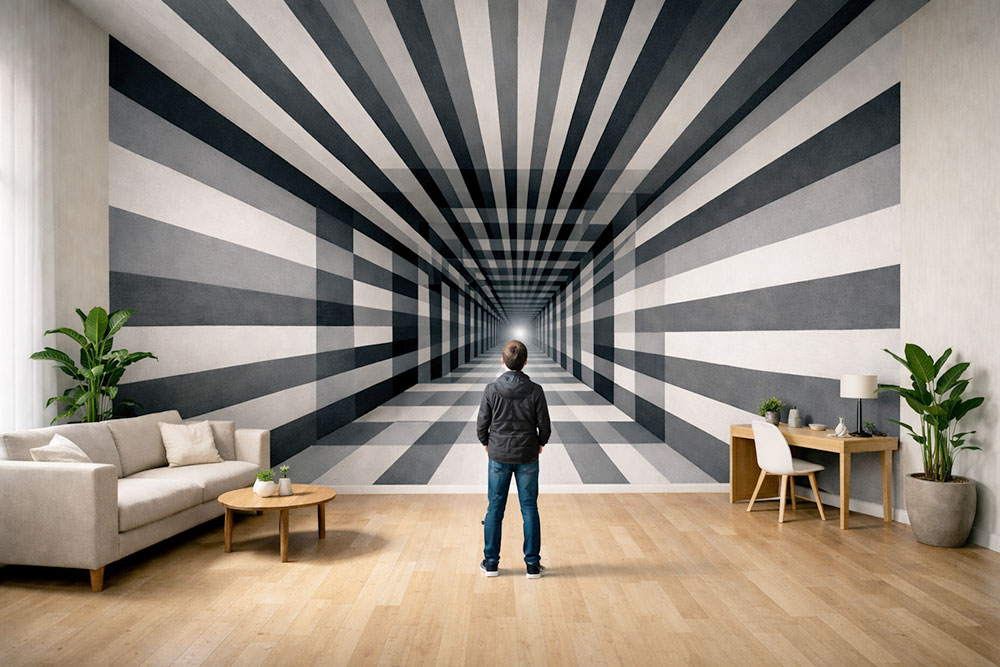
This is my favorite hack for tiny bedrooms. If you cover a wall with a flat, repeating pattern, the wall is still “there.” But if you use a mural that features a landscape (mountains, a misty forest, or a horizon line), you essentially dissolve the wall.
The eye doesn’t stop at the plaster; it travels “into” the image. It gives the psychological feeling of looking out a massive window.
Best choices for depth:
- Foggy forests (the fade adds distance).
- Abstract horizons.
- Cloudscapes.
Trick #3: Light Colors vs. Dark Drama
There is a myth that small rooms must be painted white. That is 90% true, but there is a nuance.
The Case for Light & Airy:
Pastels, off-whites, and soft neutrals reflect natural light. The more light bouncing around the room, the larger it feels. If your room has poor lighting, stick to these backgrounds.
The Case for a Dark Accent:
Paradoxically, a dark accent wall (navy, charcoal, forest green) can add depth. If you paint one wall dark and leave the others light, the dark wall appears to recede (move backward), lengthening the room.
Rule: Only do this if you have decent natural light, otherwise it will feel like a cave.
Where Should You Put the Accent Wall?
In a small room, placement is everything.
1. The “Anchor” Wall
In a bedroom, this is the wall behind the headboard. In a living room, it’s behind the sofa. This grounds the furniture and creates a clear focal point, so the eye lands there immediately instead of wandering around the clutter.
2. The Hallway End
If you have a narrow hallway, wallpapering the far end wall draws the eye through the space, making the hallway feel longer.
3. The Ceiling (The “Fifth Wall”)
This is a bold move for small bathrooms or entryways. Wallpapering the ceiling draws the eye up instantly. It’s unexpected and chic, distracting from the small footprint.
3 Beginner Mistakes to Avoid
Mistake #1: The “Box Effect”
Do not wallpaper all four walls in a tiny room with a bold pattern. It will feel like you are living inside a gift box. Stick to one feature wall to keep the room breathing.
Mistake #2: Using Tiny, Busy Patterns
Avoid “micro-patterns” (like tiny polkadots or small florals) in small spaces. From a distance, they look like visual noise or clutter.
Better: Go for large-scale patterns. Big leaves or wide geometrics actually make a space feel grander and less cluttered.
Mistake #3: Ignoring the Color Palette
Ensure your wallpaper shares at least one color with your existing furniture or rug. If the wallpaper clashes, the room will feel chaotic and, consequently, smaller.
My Top Picks for Small Spaces
Here are a few peel and stick options specifically chosen to expand your space visually.
1. The Height Booster
Why: Adds texture and height without overwhelming color.
2. The Room Expander
Why: Adds infinite depth to a windowless wall.
3. The Light Reflector
Why: Metallic accents catch the light and bounce it around the room.
Transforming a small space isn’t about magic; it’s about strategy. Pick your illusion, peel the paper, and enjoy your new “extra” square footage.