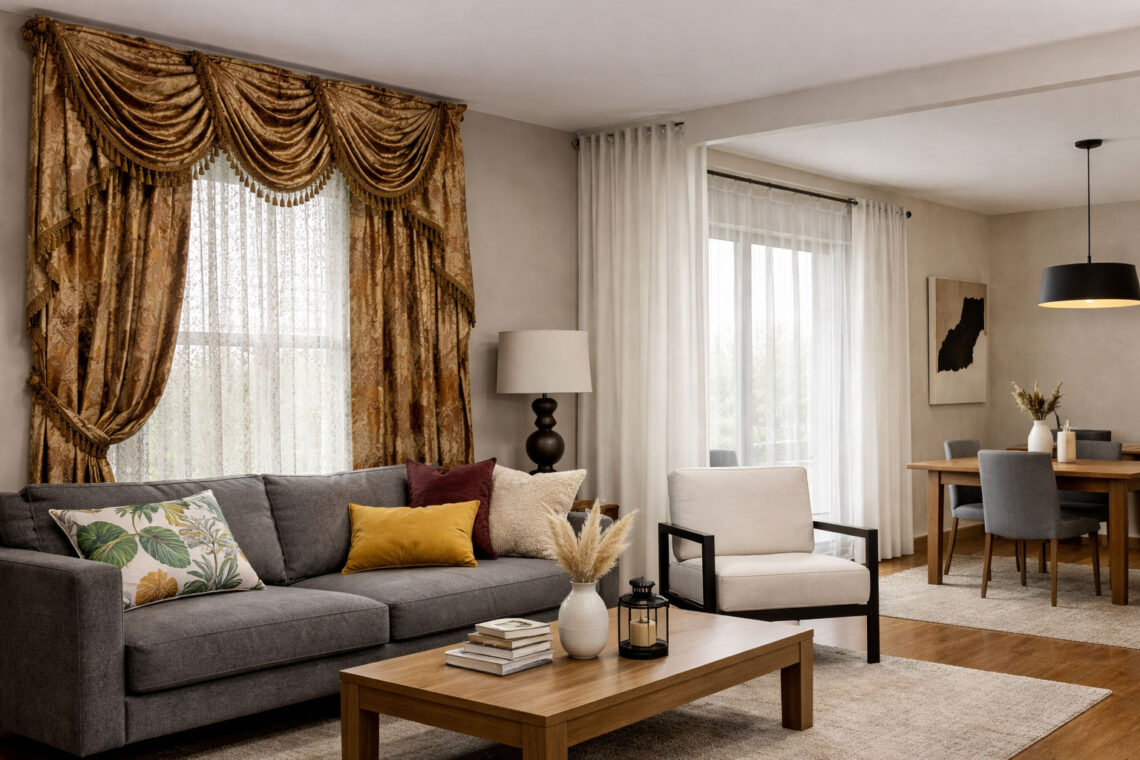
In small spaces, an interior is not decoration — it is a closed system.
Every element affects illumination, heat circulation, visual volume, and even mood.
Based on 28 moves across 7 countries, I’ve come to a practical conclusion: in smaller spaces, traditional window drapery more often disrupts balance than supports it.
Curtains are rarely neutral. They actively interfere with the physics of a space.
1. Visual Noise and Distortion of Proportions
In spaces under 30–40 m², any additional volumetric element acts as visual weight.
Window textiles create several effects:
Reduced daylight penetration.
Even when pulled aside, heavy fabrics partially block natural light. The loss may seem minor, but deeper in the room it is felt as reduced contrast and a “flattening” of light.
Fragmented vertical lines.
Curtain rods, folds, and dense fabric introduce horizontal breaks across the wall. In rooms with low ceilings, this visually reduces height.
Optical narrowing of the opening.
Fabric positioned along the sides of a window creates a “frame” that reduces the perceived size of the light source.
As a result, the space loses coherence — what I call visual noise appears.
2. Thermodynamics and Convection: Hidden Losses
Experience with insulation and heating systems shows one of the most common mistakes: covering radiators with curtains.
Warm air rises from the radiator, forming a convection current.
When fabric blocks this flow:
- heat concentrates between the window and the textile
- the glass warms instead of the room volume
- the heating system operates less efficiently
Even partial obstruction disrupts circulation.
In cold climates, this becomes especially noticeable: the room heats more slowly, and the sensation of draft increases.
3. Light as a Filter: Color Temperature and Material Distortion
Any fabric functions as a filter.
Light passing through colored textile changes temperature and spectrum.
In regions with limited sunlight, this can lead to:
- distorted color perception
- muted natural materials
- reduced textural contrast
Wood loses depth, stone appears flatter, metal becomes dull.
If the goal is to preserve the integrity of materials, an additional color filter often works against that objective.
4. Living with Animals (and a Nightmare for Curtains 🙂)
Over 8 years of working with cats, I observed a repeating pattern:
- curtains are perceived as vertical routes
- curtain rods become load-bearing points
- fabric quickly turns into a scratching surface
Beyond mechanical risks, there is also a hygiene factor:
the lower portion of curtains accumulates fur and dust within direct reach of the animal.
In small apartments, this can easily become your personal corner of chaos 🙂
5. When Curtains Are Truly Justified
Abandoning curtains is not a dogma. There are situations where they are technically justified:
- acoustic dampening in empty concrete spaces
- the need for complete blackout for sleep
- lack of alternative privacy solutions
The key question is whether the textile serves a function — or simply reproduces habit.
6. So What’s the Alternative?
If privacy or light control is the goal, more precise solutions exist:
- interior shutters or blinds (adjusting light angle without blocking heating flow)
- frosted film on the lower third of the window (“café effect”)
- roller shades fully retracted during daylight hours
These allow light control without adding visual weight.
Curtains themselves are not inherently the problem.
Automatic use of them is.
In small spaces, every element must justify its presence — technically and visually.
Remove excess textile, and the system begins to function more cleanly:
- light travels deeper
- heat circulates more freely
- proportions become clearer
A room is an instrument.
And sometimes, to achieve clean resonance, you only need to remove a single false note.
